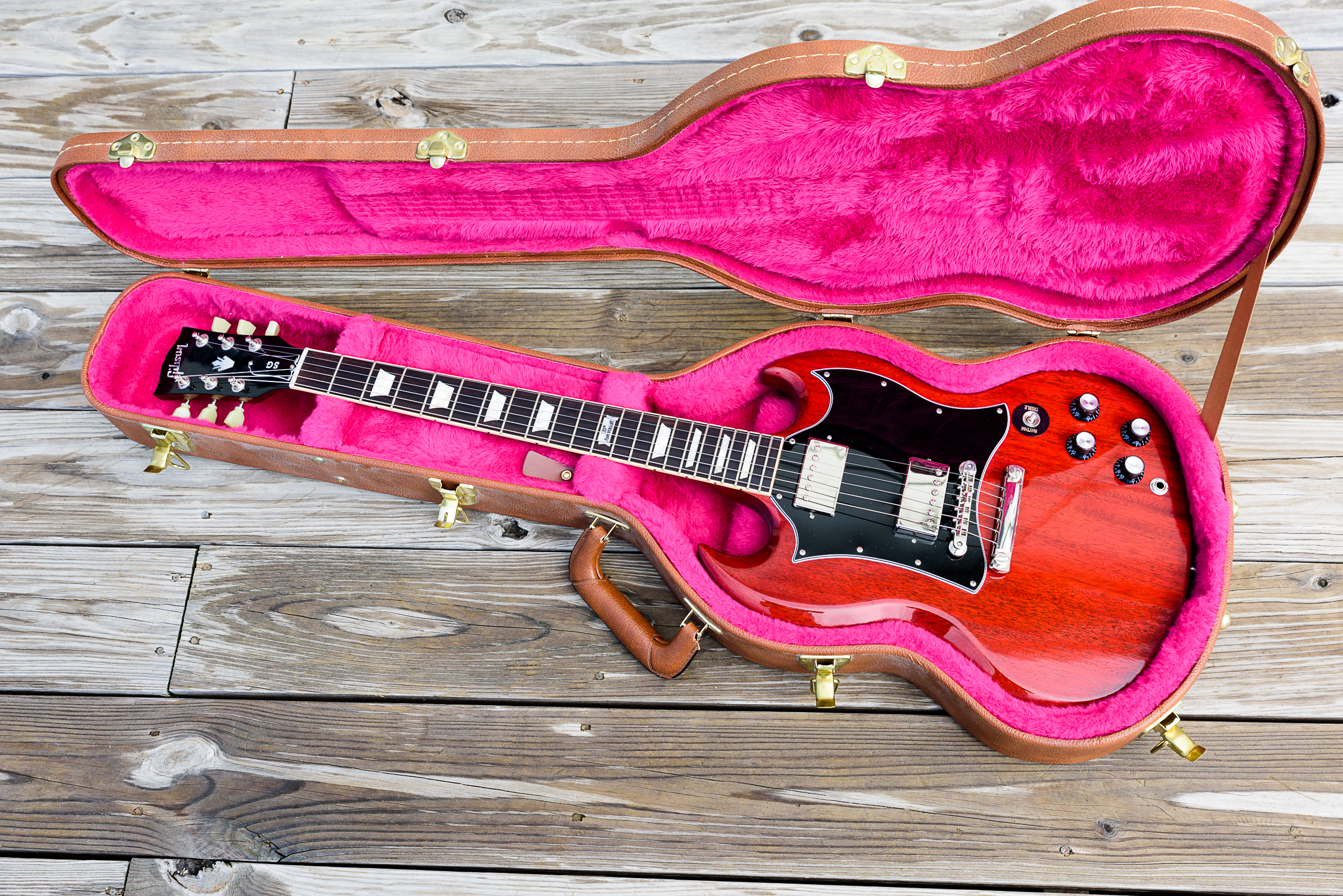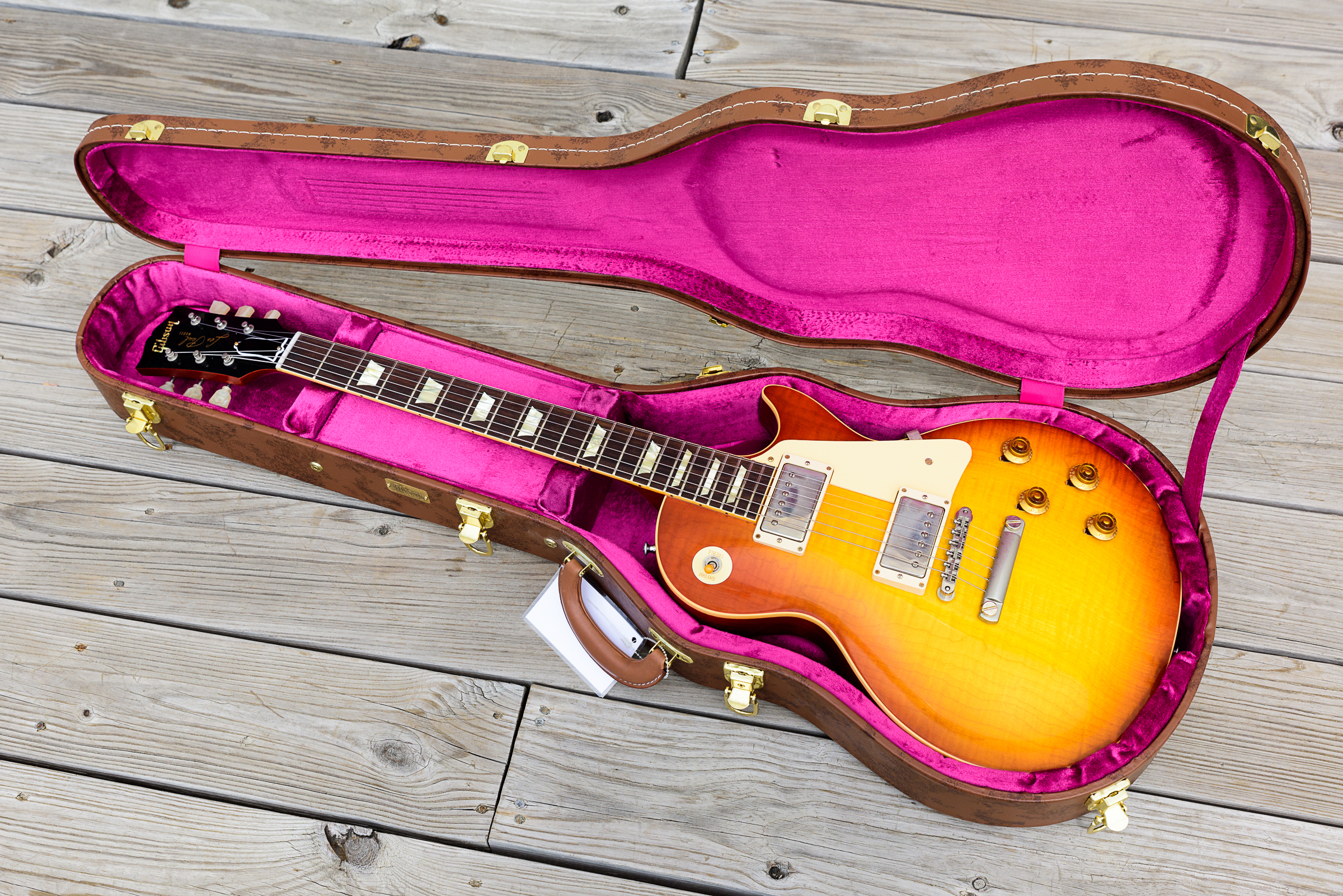
Gibson guitars are divisive. Go search your internet forum of choice for “gibson” and you’ll come across posts ranging from high praise to rants about their high prices and lack of quality control. And yet, Gibsons remain popular guitars, right up there with arch-rival Fender. I think it’s because of their iconic designs (of course), but also because if you ever pick one up, you feel like you’re holding a piece of history. Gibson guitars are still, after all these years, set-neck guitars featuring a large amount of handwork and that take a lot of time to make. Augmented by machine, yes, but as of today no machine is going to glue on a neck for you, no machine is going to file down the binding on the neck for those little fret “nibs”, no machine is going to spray the “sunburst” finish, and no machine is going to make that finish dry any faster.

Compare this to Fender electric guitars. Leo Fender was a smart guy and had mass-production in mind when developing the bolt-neck style guitar. Take a neck, take a guitar body that was painted separately, bolt it together, and you are done. No waiting for glue to dry. And Fender, for the most part, has done away with the use of nitrocellulose lacquer (“nitro”) that takes weeks to cure, opting instead for catalyzed finishes such as polyurethane that dry thin, hard, and fast. And while a few models sport “burst” finishes, you see a lot more solid colors in their lineup.
Also compare this to PRS guitars. PRS, founded by Paul Reed Smith in 1985, is a much newer company than either Gibson (founded in 1902 by Orville Gibson) and Fender (founded in 1946 by Clarence Leonidas “Leo” Fender.) Paul Reed Smith is obsessive with detail, and the guitars his company makes show it. Great and consistent quality, fit, and finish. Necks are done by hand as well, and they aren’t budging on how long it takes to do them properly. Go and pick one up and you feel like you’re holding a precision instrument. Utterly reliable.
But sometimes you don’t want precision. Sometimes you want tradition, even if “tradition” is a bit rough around the edges.
I’m going to use a car analogy: if guitars were cars, PRS would be something like a German automobile. Stellar and machined to tolerances usually reserved for aerospace. Fast as hell and carves corners like a scapel. But utterly without humor. Fenders would be American cars, designed to be made with average parts thrown into a super efficient assembly line in Mexico and churned out by the thousands per day. Has cupholders. All identical and un-special.
Gibsons would probably be British cars, handmade using old school methods by folks who mostly pay attention. Not flashy enough to be Italian, but probably as reliable. They ooze heritage. and this tends to overwhelm the parts used in assembly. That door handle falling off? Pure heritage.
I like Mercedes Benz. I like Ford. But neither of these are Jaaaaags.
And this is pretty much how I feel about Gibson in relation to other guitars. Open up the case and you get hit in the face with the smell of nitro lacquer. Pick one up and look closely to see where the person putting it together started thinking about lunch, and forgot that they were assembling a $2000+ musical instrument. Play one and listen to it honk and rip. And set it back down again to admire the swell of the Les Paul’s carved maple top, the gentle curves of the ES-335, the vivid cherry and pointy horns of the SG, the futuristic shapes and angles of the Firebird, Explorer, and Flying V. All flawed and all spectacular, and all designed by (or under the tenure of) Ted McCarty, who retired from being Gibson’s president in 1966. So these designs are old, just like your parents.
I do admit, however, that for the amount of money these things go for, the fit and finish could be better. And good news, the new Gibson leadership believes that too. After conducting a long and exhaustive study on how their guitars were made, Gibson concluded that better factory lighting would probably help workers see what they were doing.
The fact that this was even a finding helps illustrate how little the former leadership cared. In 1986, Henry Juszkiewicz, David Berryman, and Gary Zebrowski bought Gibson from Norlin Musical Instruments, rescuing the company from mismanagement and decreasing quality. Henry became CEO. After successfully revitalizing Gibson and bringing the Les Paul back from intensive care, Henry then put his Harvard MBA to good use to repeat all the mistakes Norlin made and then some. He proved unwise with the company’s finances, acquiring firms like Teac and Onkyo to try and make some kind of big music gear conglomerate out of it all. He proved an ineffective leader, losing (usually by terminating) great talent and knowledge, including Edwin Wilson and Rick Gembar, two luminaries in the Gibson Custom Shop who did a hell of a lot of research into backwards-engineering the original Les Pauls from the 50’s so that today’s Gibson could replicate them. And he led some pretty god awful product launches, trying to modernize Gibson’s guitar models and severely underestimating the pushback from customers who didn’t want any of that.
A great example was the Firebird X. It was a bold play and a disaster. Here, watch a demo. And get a load of this press photo, showing Henry swinging some type of SG into a cinder block:

The utter failure of the Firebird X remained a sensitive topic for Gibson while Henry was still around. Gibson visitors were kindly reminded to not mention it.
Another great example was the 2015 model year, in which Gibson decided to make some money off of its acquisition of “auto tuning” technology from a German firm called Tronical, and put robot auto tuners on every guitar. The uproar was enormous. No one wanted a 2015. Well, maybe some younger players did. But because they were all broke, they bought Ibanez instead.
Henry, probably puzzled with how to handle the burgeoning millennial market segment, decided to make it a non-issue entirely by raising prices, ensuring that no one under 40 would be able to afford a Gibson. It got pretty unreal, with Les Pauls (more specifically, the “Les Paul Standard” benchmark model) selling for around $2600 in 2016 to over $3000 in 2018.
The real reason was probably because Henry believed that Gibson guitars were “Veblen goods“, and boy did he put that theory to the test. And if folks wanted a cheaper Gibson, well hey, there was the no-frills Faded, Tribute, and Studio lines, and the entire Epiphone brand. But he seemed to ignore the fact that once you go past a certain price point, customers would appreciate it very much if the door handles remained on the car.
Despite all this, Gibson (the guitar company) was profitable. Unfortunately, Gibson (all the other brands) was hemorrhaging money, and Gibson Brands declared Chapter 11 bankruptcy in May 2018. All those other firms were spun off, and Henry was no longer CEO (despite probably desperately trying to hold on.) He was replaced by someone with a better education and background.
James “JC” Curleigh, bachelor’s from Saint Mary’s University, was able to turn around a company struggling with many issues Gibson was facing. That company was Levi’s, once known for making great jeans, and more recently known for making crappy ones plus some other stuff no one wanted. He pivoted that company back to profitability by focusing on the traditional. And he’s looking to repeat that strategy at Gibson, introducing a “Original Collection” line of guitars that are basically the guitars Gibson made back in its heyday, with all the more modern stuff under its “Modern Collection” for that younger demographic unbound by tradition that, by now, have managed to earn some money by streaming on Twitch.
He also understands social media, something Henry was never able to do. Look at Fender’s YouTube presence. It’s huge, with over two thousand videos, over 400k subscribers, and counting. Gibson had a handful of videos and a sorry Facebook page. Probably also an Instagram but no one cared. Now, Gibson has Mark Agnesi, someone who knew YouTube well enough to make a sleepy guitar store into a big YouTube deal, making videos of its new lineup. And people are loving it. (They’re subscribing, at least.)
And prices are now back down to earth. The Les Paul Standard goes for $2499. It hasn’t been this cheap for years. And having held and played two of them, a 50’s model and a 60’s one, they are a whole lot more guitar for the money. And they are selling everywhere. Sweetwater is going through them like mad, and I check every day to find one with a great flame-y top. The two that I saw in-person sold in a week.
Will JC repeat his Levi’s win with Gibson? Only time will tell. Fender has a head start of a few light years, having done actual market research. And PRS still maintains a high and consistent level of quality, probably because they refuse to scale as large as these two behemoths (and I don’t fault them for that.) But the beginnings of a turnaround are there, just in time for the 60th anniversary of Gibson’s most iconic guitar model, the ’59 Les Paul. Good timing!
Will I get one? Probably. I have a 2016 Les Paul “Traditional” that’s pretty good. It’s close to the Original Collection Les Paul Standard in terms of features. It’s also my first Les Paul ever, so it has sentimental value. And it’s well-built and made, so I guess they were paying attention that day.
On the other hand, I think the new ones are better. I paid $2200 for the 2016 in 2016 dollars, and replaced some parts with better aftermarket ones, so it ended up being more expensive than today’s $2499 Standard. And I recently sold my first Gibson ever, a 2014 SG, to a happy buyer on Reverb, so I’ve learned to say goodbye to things. I think now it’s about finding “the one” and that, for me, will probably involve finding one at the local Guitar Center, trying it out, and being amazed enough to fork over the cash. But that’s probably only a matter of time, as the new models make their way into stores.
There are still reports on the internet about quality control issues here and there, and it’s probably going to take more than just better lighting to iron those out entirely. But I think Gibson is back to doing things right, and I’m not the only one. And they’re still set-neck, hand-painted, maple and mahogany, just as they have been for the past 60 years. If Gibson continues to struggle, I don’t think it’s going to be because they can’t make great guitars.
I think it’s going to be more about continuing their social media push to reach out to growing market demographics. Again, Fender got the head start, especially with women. But Fender has also raised prices and revamped their lineup to be more contemporary and is experimenting with some new and sometimes weird designs. (Sound familiar?) It’s strange when a bolt-neck guitar with the obscure “Made in Corona” stamp is around the same retail price as an unambiguously Made in USA set-neck, nitro-finished guitar.
It’s going to be a tough fight but I think Gibson is making the right moves. And at the end of the day, there is absolutely nothing else like opening a Gibson case, smelling the vanilla of the lacquer, and picking up what’s inside. Nothing else like holding a weighty, fat-necked, sunburst Les Paul. Nothing else like plugging it into a Marshall and hearing its humbuckers snarl. Gibson guitars have been music icons for over half a century.
And with the new generations learning about them and appreciating them, they’re probably going to continue to be for a little while more.