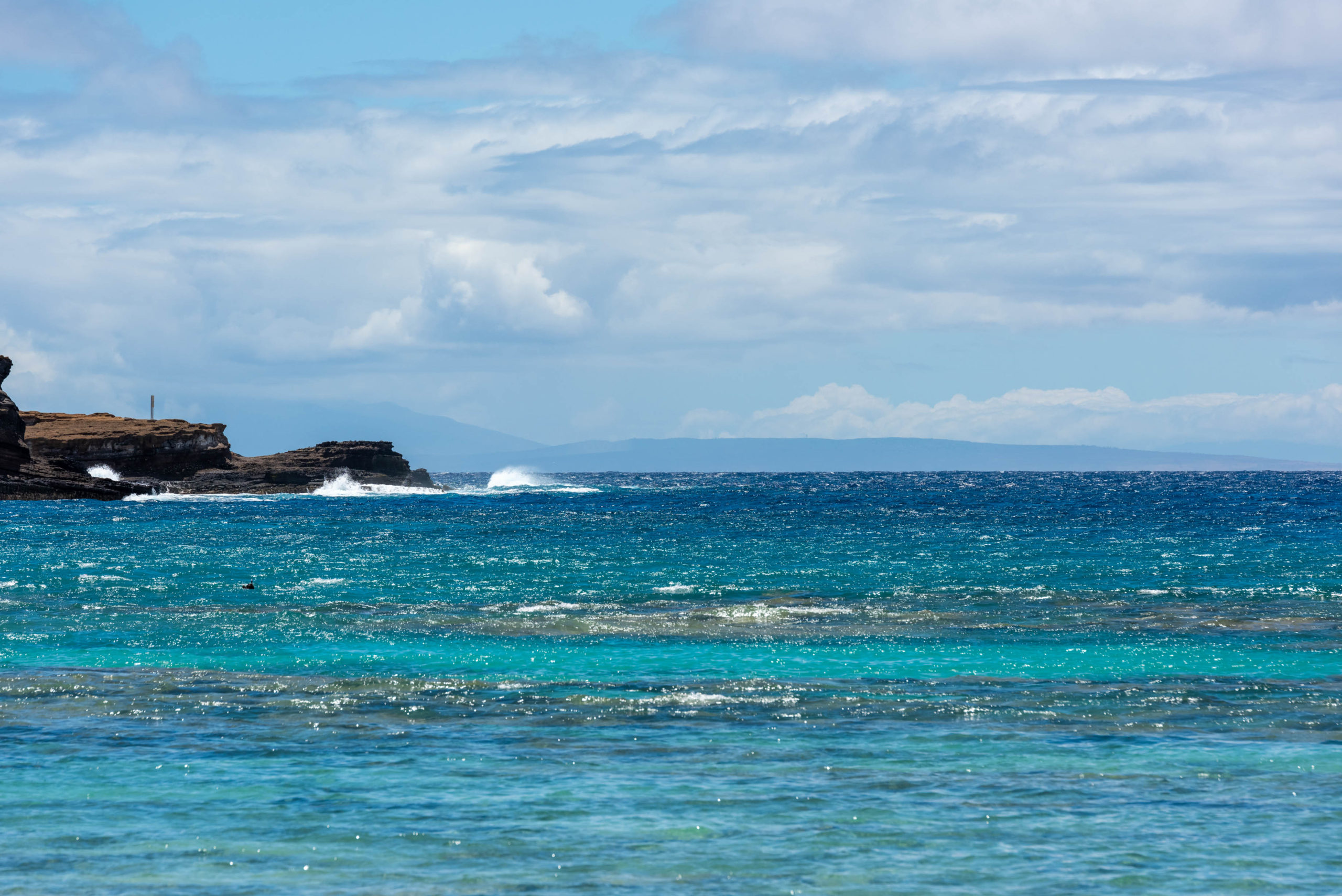
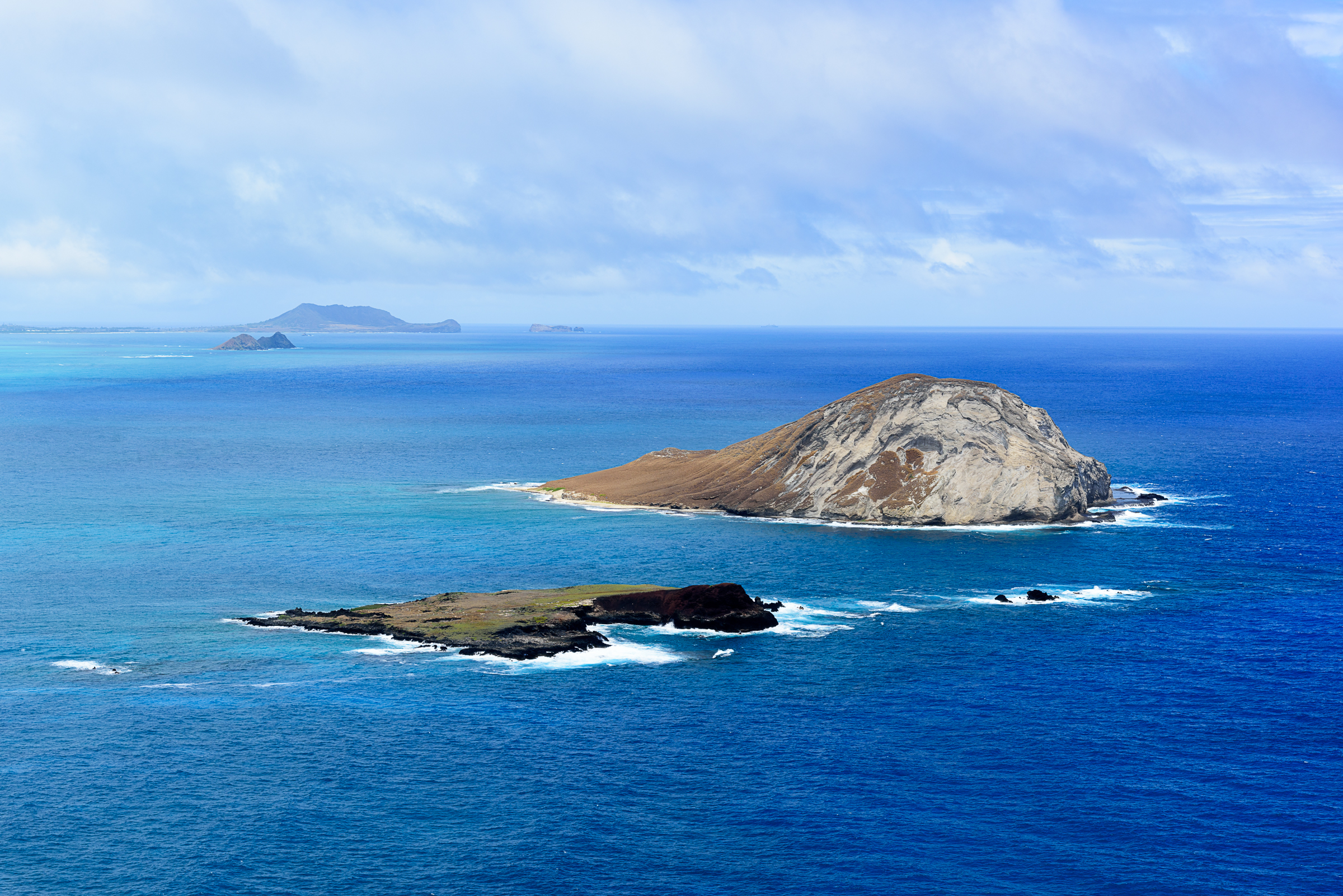
Taken from Hanauma Bay, Oahu. Maui is on the left past the rocks. Molokai is the flatter shape on the right.
On clearer days, you can see the other islands in the Hawaiian chain from Oahu. The ones in this photo are Maui and Molokai. Maui is taller and Molokai is flatter. Sometimes you can also see Lanai, which would be further off to the right. I think they all used to be part of the same land mass above sea, millions of years ago.
I haven’t been to Maui in ages, but it’s currently swamped with tourists so I think I’ll stay away for a bit longer. Molokai has a reputation for keeping to itself, which I can respect. ‘Nuff hotels already.
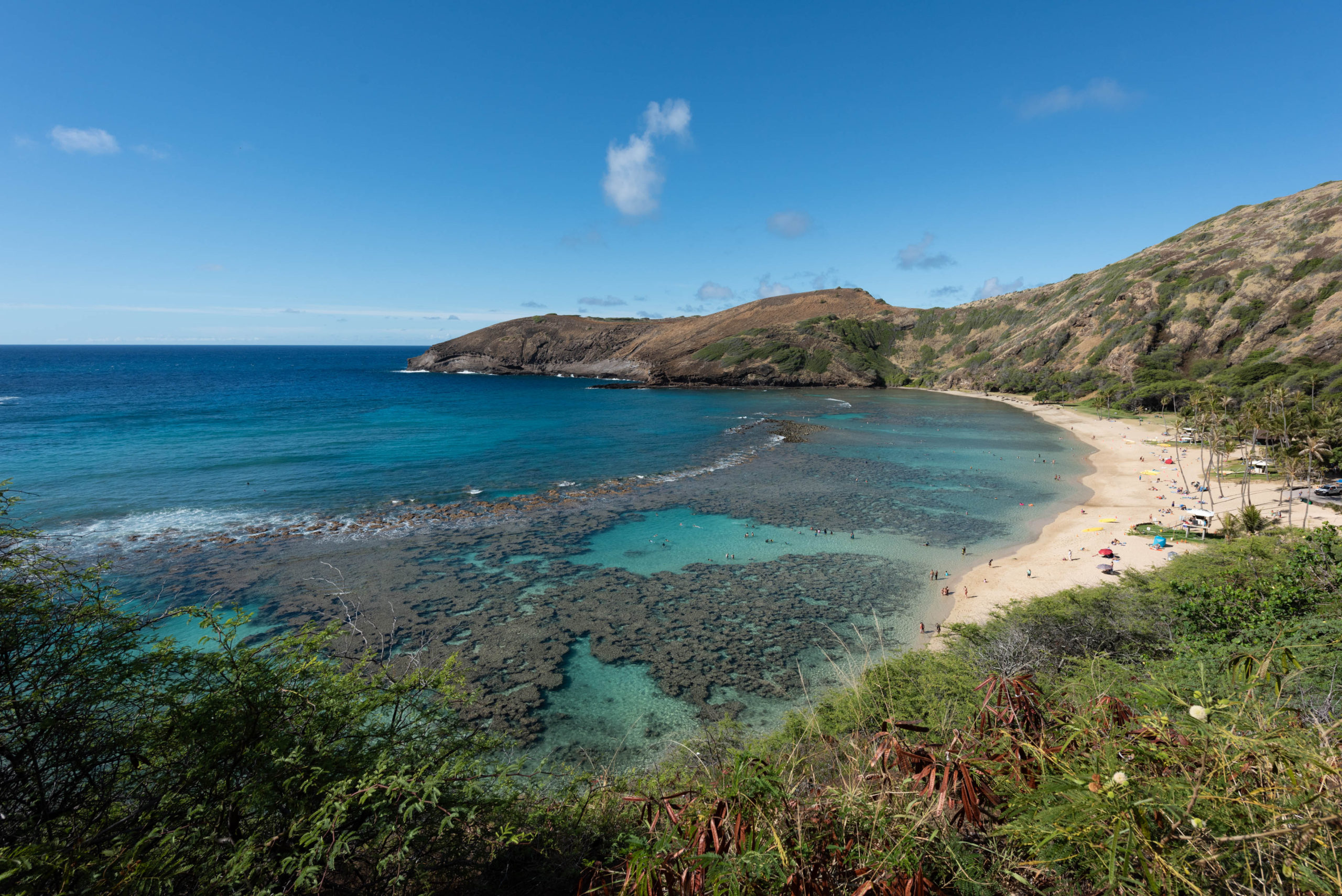
Pretty difficult to get in, but once you do it’s a treat.
I took this photo of Hanauma Bay during my most recent visit this summer. The pandemic has made traveling to Hawaii pretty difficult. Until recently, out of state vaccinations were insufficient to get past the Hawaii Safe Travels program, which meant any traveler from the rest of the United States had to get a COVID test result within 72 hours of departure. This also meant that you had to pray to get your results back within that window, which depended on how slammed the testing lab was.
Thankfully I was able to see the islands again earlier this year and even made it to Hanauma Bay via the new reservation system. The Park is now closed twice a week and has strict limits on who can visit. It’s a struggle to get in since slots fill up in 5 minutes after they open at 7:00 AM local time. However, the Park has had trouble with overcrowding in the past, to the detriment of the sea life. The current system isn’t perfect but it did make for an overall more pleasant experience for the lucky folks who got in, and I’m sure the fish are happier also.
Hanauma Bay came a long way since I remember it as a kid, back when the reefs were pitch black (because they were dead) and visitors were feeding the fish with old breadcrumbs (which didn’t do wonders for their nutrition.) These days the Park is strict on how people behave in the waters to protect the marine life, which includes the endangered Hawaiian monk seal. Please don’t touch monk seals.
There are of course other beaches in Oahu that are worth visiting, but Hanauma Bay still remains special to me.
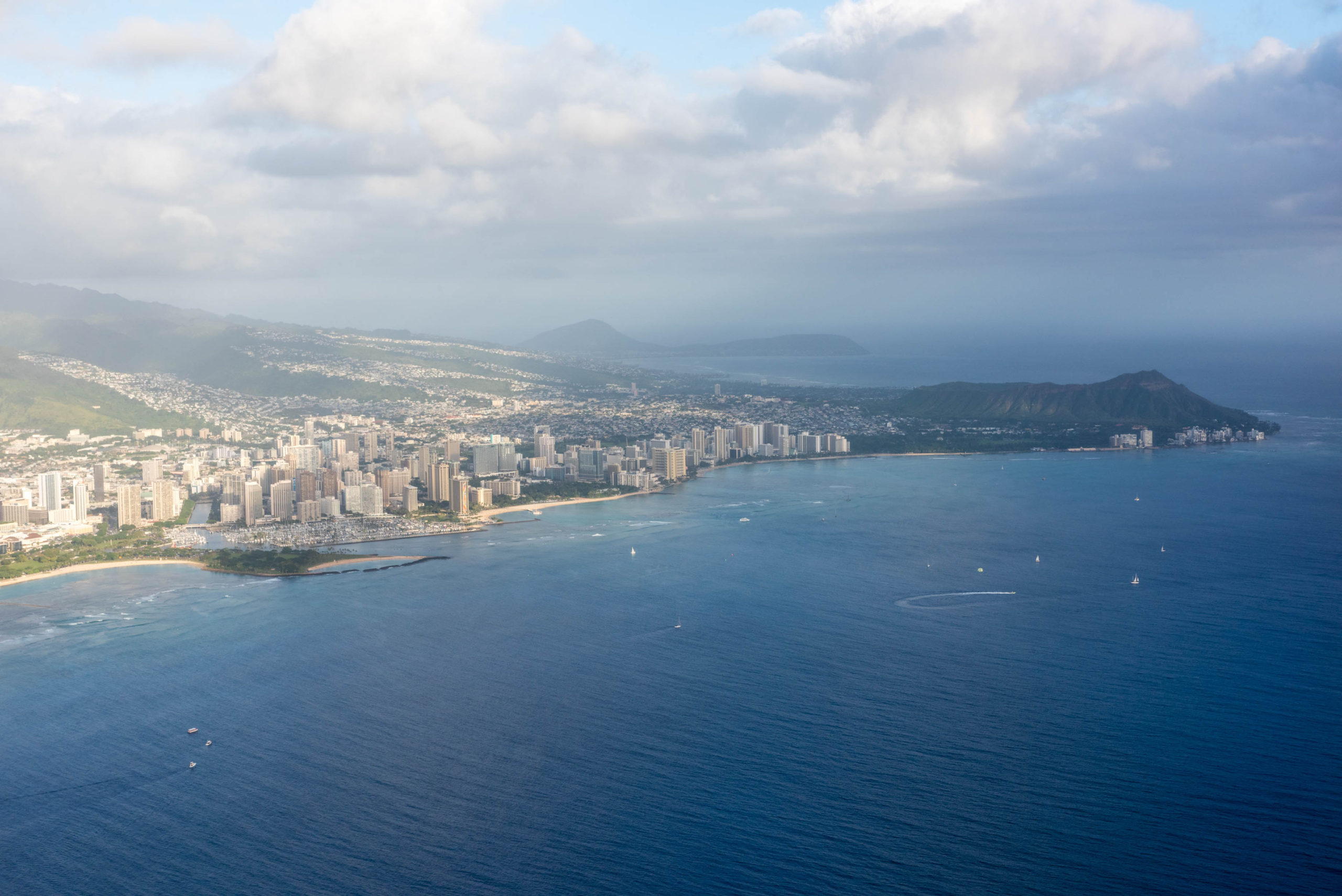
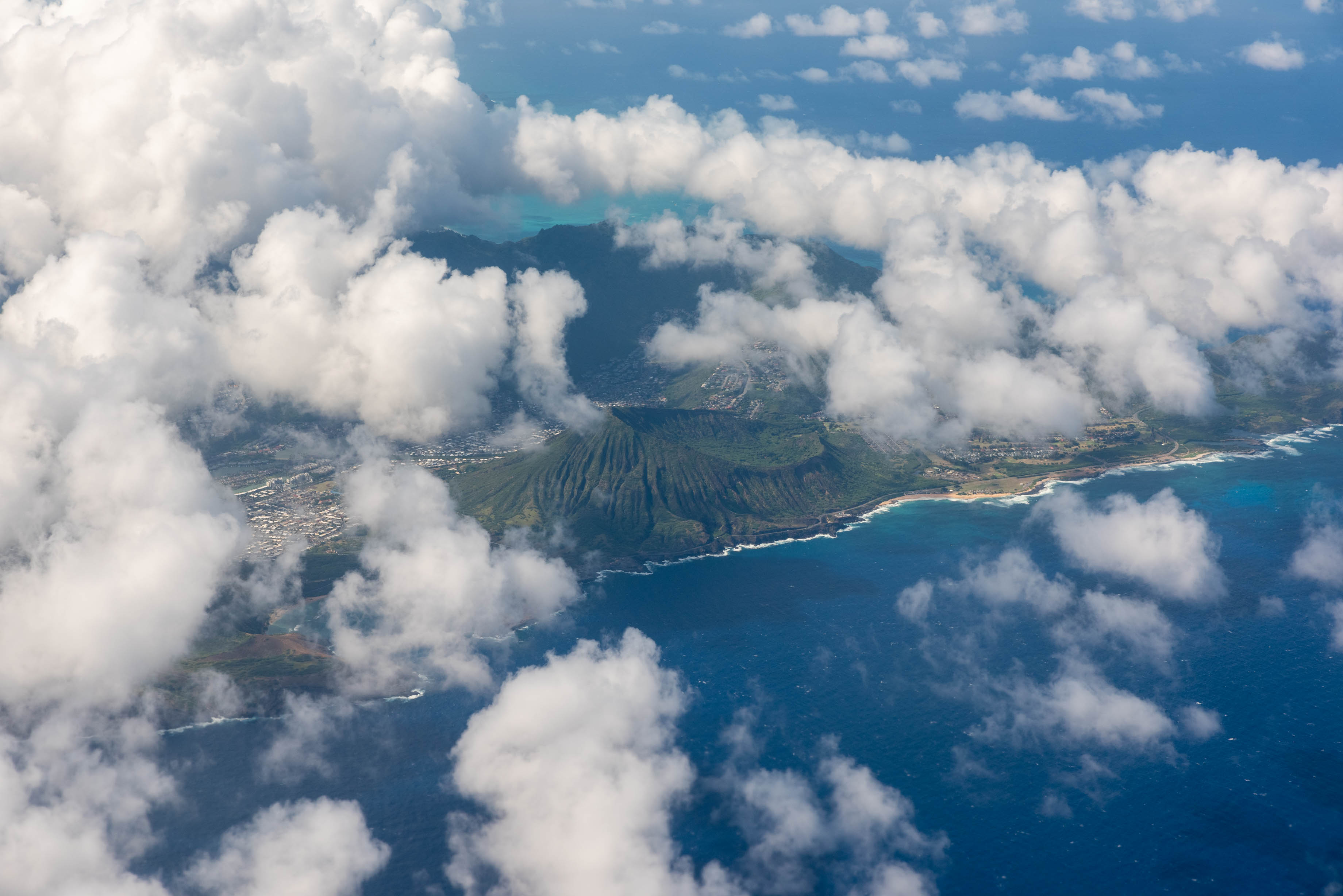
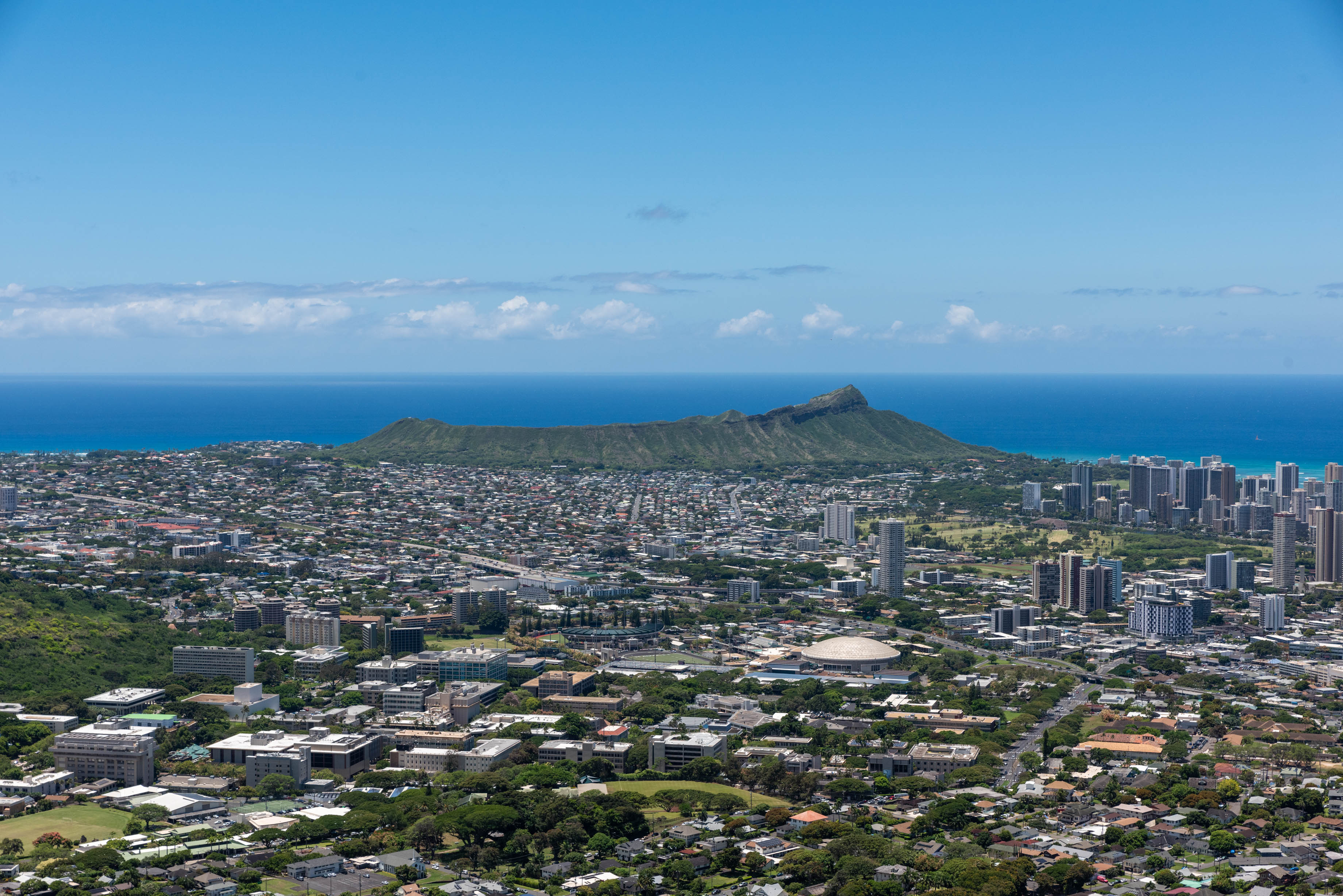
Taken during the flight back to the states, January 2020. Waikiki to the left, Diamond Head on the right. Far in the center you can see Koko Crater and Koko Head. Click for big.
It’s called that because it looks like the head of a rabbit with its ears folded back. Nothing there but birds. In the background you can see Mokapu, where Marine Corps Base Hawaii is.
The National Memorial Cemetery of the Pacific, also known as Punchbowl Cemetery because of its location in an extinct volcano crater called the Punchbowl Crater.
Koko Crater, viewed from Sandy Beach. Which as you can see, sometimes isn’t so sandy.
Whenever I meet someone new, I tell them that I was raised in Hawaii. This is despite the fact that I was only there for four short years of my early childhood. I think it’s because those years are some of the most vivid and memorable for me, and also because I wish I never had to leave.
This isn’t to say that life there was perfect. Because Hawaii is a bunch of volcanic islands in the central Pacific Ocean, anything that we use in modern life, including cars, appliances, fuel, and anything you eat that isn’t farmed or raised there, has to be flown or sailed in. As a result, everything is damn expensive. And on Oahu, the island I’m from, because there is only so much accessible land with the required infrastructure (you know, important things like electrical power), homes and property are goddamn expensive, meaning only billionaires from China can buy them. And because the growth of highways and roads has been rapidly outpaced by the influx of cars, traffic is absolutely massive. Want to get to work by 8 AM? Better leave before 6 in the morning.
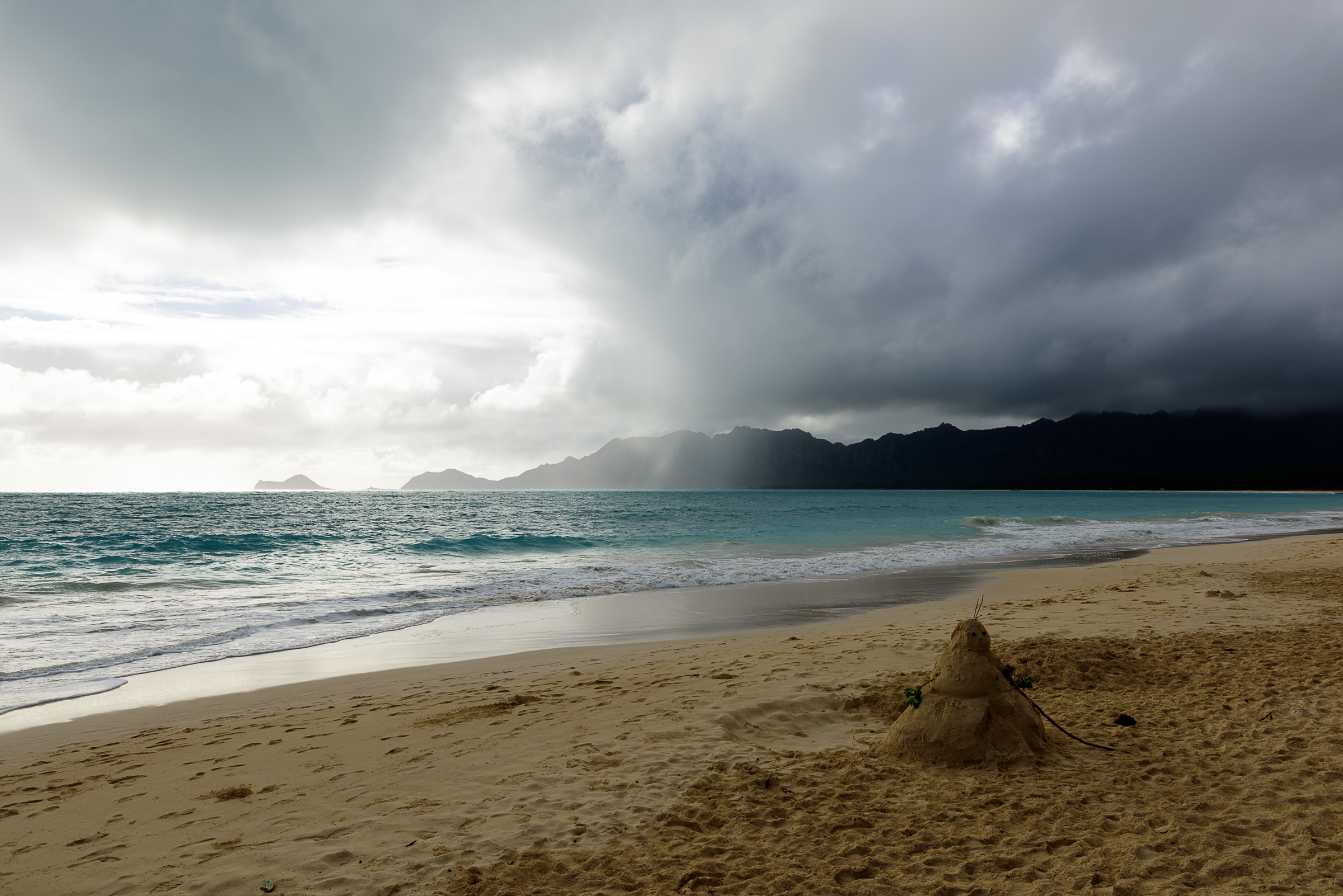
Hanauma Bay. Free admission with a Hawaii driver’s license. Good luck with finding parking. Don’t step on the coral.
But since you’re on an island with this kind of scenery, the burdens and bad news of the modern world seem far away. It becomes easy to ignore what’s happening back on the “mainland.” All the terrible stuff happens somewhere out there, and all you start caring about is what’s happening locally. You start becoming a “local,” which is what you call yourself to indicate that you’re from Hawai’i (actually pronounced “huh-vuh-ee”), because calling yourself “Hawaiian” while not being of Native Hawaiian ancestry will get you beaten up by an actual Hawaiian.
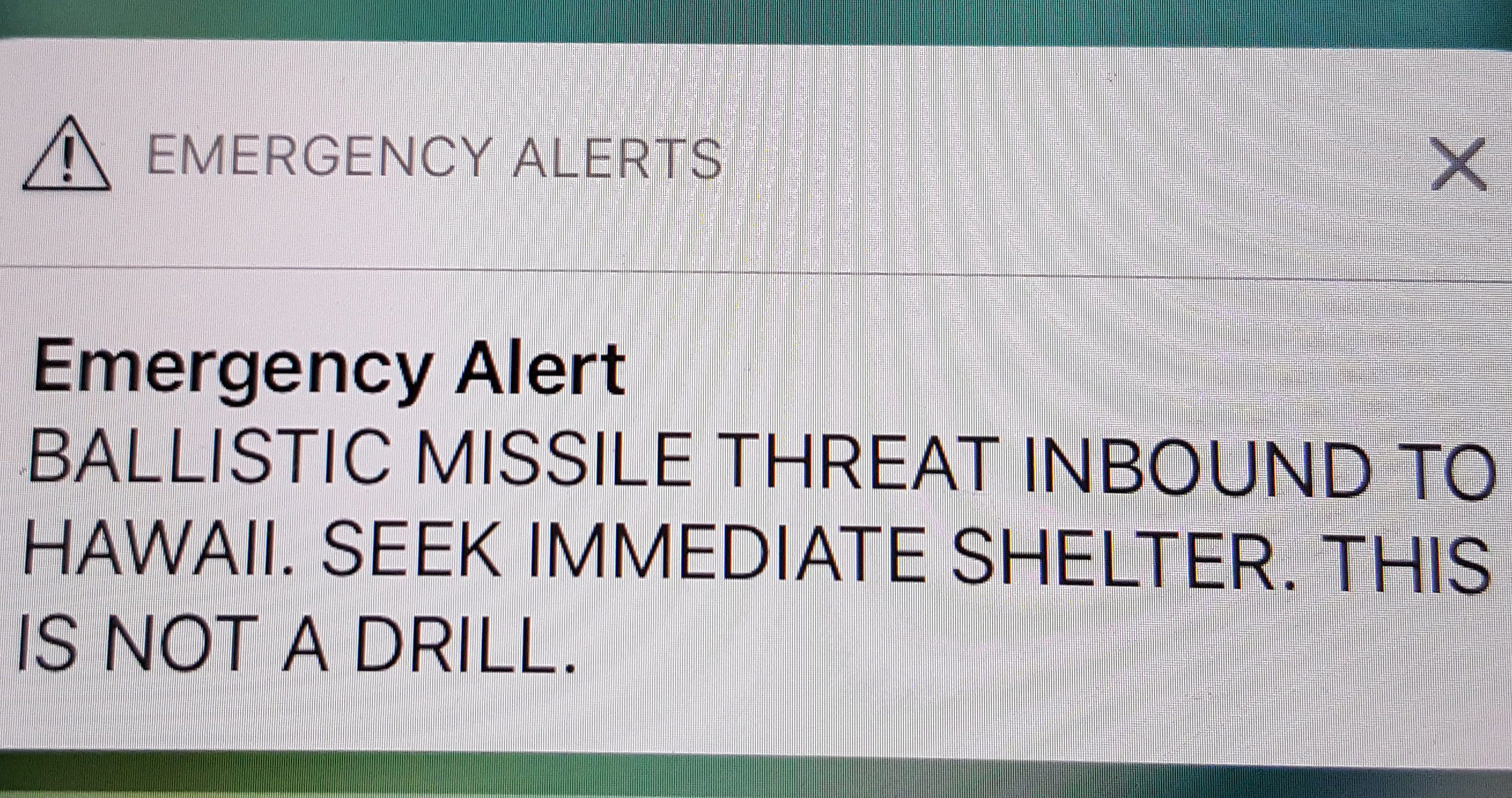
The missile alert I got while eating breakfast.
However, as the missile alert on January 13, 2018 helped remind us, this is merely a fragile illusion. Hawaii was never destined to be a place cut off completely from the rest of the world. Reading about its history, how it was first discovered by ancient Polynesians and eventually by everyone else, it becomes obvious that Hawaii is a people magnet. And as it attracted more people, they brought with them their ambitions and their problems. One group of people, the United States of America, decided that Hawaii was awesome enough to annex. And so they did, overthrowing the ruling queen. About 40 years later another group of people, Imperial Japan, decided that Hawaii, with all the Americans and their war machines on and around it, was awesome enough to bomb. And so they did, destroying a lot of American ships and ending a lot of lives. To this day, Hawaii remains a vital location of strategic and economic importance to the U.S. And as a result, it remains an attractive target for, oh I don’t know, some folks in Asia with access to long-range weaponry that can potentially carry nuclear warheads.
If you want to learn more about Hawaii’s ancient and modern history, pay a visit to Bishop Museum’s Hawaiian Hall.
It doesn’t take the threat of military action to demonstrate how fragile Hawaii really is. Economic forces are plenty enough. Tourism is both Hawaii’s dearest friend and worst enemy: With jobs and economic prosperity comes pressure on its ecosystems, as visitors flock to all areas seeking the best selfies, trampling over everything and leaving lots of garbage behind. Traffic between Honolulu and the North Shore of Oahu, once fairly idyllic, is now hilariously bad as folks get fed up with the crowds at Waikiki and look for alternatives on the miles of 2-lane roads going from Honolulu to Haleiwa. Neighborhoods fear of getting overwhelmed by more crowds and more hotels. And the state government isn’t exactly the best at dealing with these issues: its attempt at alleviating Oahu traffic with a downtown light rail system has turned into a $9 billion boondoggle. About $1.75 billion of that could have gone to replacing the 88,000 cesspools leaking sewage into the ground, drinking water, and ocean. Funds diverted from normal road maintenance towards keeping the rail project afloat has resulted in potholes everywhere.
There’s a song that plays on KINE FM, one of the local stations that plays a lot of music from local artists. The song encourages listeners to imagine what the old native Hawaiians would think and feel to see these jewels of nature turned into highways and parking lots. And the song’s conclusion is that they would probably think it really sucks. But the old native Hawaiians knew how to coexist with the land in a way us modern people can’t, or won’t.
A critically endangered silversword.
There are forces at work in the opposite direction, against the rising influx of tourists, the property getting snapped up by rich foreigners, and the state’s own ineptitude to deal with home problems. These range from attempts to reassert Hawaii’s sovereignty, to scientific work on marine and rain forest biology to determine the impacts of climate change, to “Kill Haole Day”, a day on which if you are of obvious white Caucasian descent you do not go to school. Obviously, some of these are more conducive to Hawaii’s survival in the 21st century than others.
As with any set of complex problems, there are no simple and easy solutions. So whenever I’m lucky enough to take a break to visit the islands, I try not to take things for granted. It’s the closest thing to paradise we have, and it would be a shame to lose it. But there’s always a chance we might.